
Edition 1 · Oct 13, 2026
Your next big decision needs a receipt
Eight lines to write before you commit, and a template you can copy today.
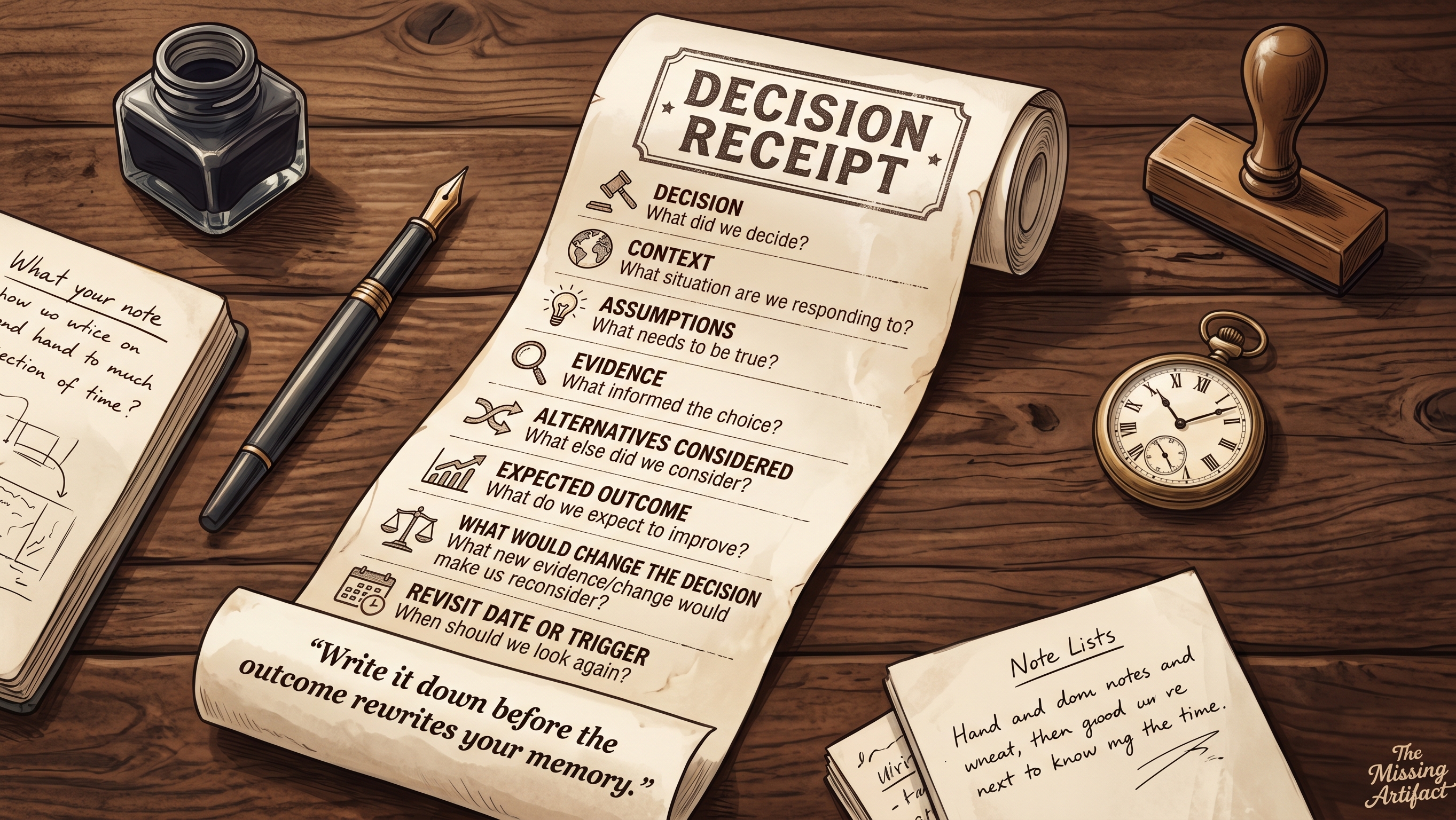
This is the first edition of Good Option. Last month at ProductCamp Austin (PCA35), I gave a talk called “You Were Wrong. Now What?” The part that resonated was the simplest one: write a receipt for your big decisions. So that’s where this starts. Every other Tuesday I’ll share a few ideas on product, decisions, and AI, plus one thing you can use the same week.
Decisions / Your next big decision needs a receipt
Six months after a big call, ask the team why they made it. You’ll get more than one answer. I’ve sat through enough of those look-backs to stop being surprised: even with the same team in place, people remember the decision, and the reasons for it, differently.
That forgetting has a cost. I call it the amnesia tax: re-debating settled questions, rebuilding analyses that already exist, judging old calls against facts nobody had at the time. The fix starts with writing decisions down. The real question is how much.
Between nothing and a business case
Most teams land at one of two extremes. Either the reasoning lives in a chat thread and a few people’s heads, or a big bet goes through a formal business case or stage gate. The first leaves nothing to check later. The second is valuable but heavy, so most calls that matter never get one.
A Decision Receipt sits in between. It’s short, it’s for the bets that matter, and you write it while the reasoning is fresh. Not every ticket needs one. But if you’re making a big investment without a business case or other formal process, create a receipt for yourself.
The eight lines
In the talk, I walked through the receipt one field at a time (the full template is below):
- Decision. Get it down firmly. It may be more than one thing.
- Context. Write it for someone reading it two years from now, maybe after you’ve left.
- Assumptions. This one is critical: assumptions change, and so do people’s memories of them.
- Evidence. Say where to find it. You don’t have to paste it in.
- Alternatives considered. The paths you passed on, and why.
- Expected outcome. Outcomes, not output.
- What would change the decision. Name it now so you can watch for it.
- Revisit date or trigger. A date, or an event, that brings it back.
A hypothetical example. Decision: pause the native app and put two quarters into mobile web checkout. Assumption: most mobile buyers are occasional, not daily. What would change it: repeat mobile purchases pass 40 percent of orders. Revisit: end of Q2, or sooner if that number moves.
Why it matters when you’re wrong
The talk was about what to do after a bad call, and the receipt makes that question answerable. A good decision can have a bad outcome when the world changes. A bad decision can win on luck. Without a record of what you knew and assumed at the time, you grade every call on how it turned out, and learn the wrong lesson.
I’ve been on the wrong side of this. At one startup, a competitor went out of business, and suddenly there were a lot of customers for the taking. We stretched our idea of our ideal customer, and getting that broad at that stage hurt our longer-term growth. Looking back, we were lying to ourselves a little. A written Assumptions line makes that harder to do.
During the session, one attendee said, “I love your receipts,” and wanted them at work “to go back and say no, this is the problem we were trying to solve.” That’s the use. Receipts improve how a team decides. They aren’t for grading people. The goal isn’t deciding that Bob makes good calls and Joe doesn’t.
Try it this week
Pick the biggest decision on your plate this week. Before it’s final, fill in the eight lines below. Keep it to a page, put it where your team will find it, and put the revisit date on the calendar. Start with your own team, not the whole company.
Watch the talk: You Were Wrong. Now What? (PCA35, 38 min)
Copy this: the Decision Receipt
Paste it into a doc, a ticket, or your wiki.
DECISION RECEIPT
- Decision: What did we decide?
- Context: What situation are we responding to?
- Assumptions: What are we assuming is true?
- Evidence: What informed the choice, and where is it?
- Alternatives considered: What else did we weigh, and why not?
- Expected outcome: What do we expect to improve?
- What would change the decision: What new evidence would make us reconsider?
- Revisit date or trigger: When do we look again, and who brings it back?
Product / Teams have more information than ever, and can’t find it
(via Atlassian, State of Teams 2025)
Atlassian surveyed 12,000 knowledge workers and 200 executives and reports that leaders and teams waste 25% of their time just searching for answers. It’s self-reported, from a company that sells collaboration software, so treat the number as directional. My take: a lot of that searching is re-deriving decisions nobody recorded the reasons for. Don’t start with a new tool. Start by writing receipts for the three decisions your team keeps coming back to.
AI / Let AI find the old decision. Don’t let it write the record.
In my view, one of the most underrated uses of AI on product teams is unglamorous: retrieval. Point an assistant at your meeting notes, tickets, and docs, and ask, “Have we decided anything about this, and why?” It can surface threads a person wouldn’t think to search for. Two guardrails keep it honest. First, every answer links to its sources, so anyone can check the original. Second, a person confirms the reasoning before it goes on a receipt. AI summaries can be confident and wrong, and a decision record is the last place you want that. Let AI do the finding. Keep people on the deciding and the recording.
From ProductCamp Conversations
Customer Interviews: How to Do It Regularly and Effectively (with Kevin Palmstein), Oct 3
Takeaway: Treat customer interviews as a visible product output. Count the conversations, share what you heard with the rest of the organization, and show leadership how those insights turn into action.
“Your opinion in these interviews does not matter. You are there to listen and to shut up.” — Kevin Palmstein
Little Is Learned in Your Office (with Steve Johnson), Oct 10
Takeaway: AI is a “yes, and” for product managers, not an “instead of.” Use it for pattern-finding, but your competitors are asking the same models. Judgment and firsthand customer contact are what set you apart.
“Little is learned in your office. So if the goal of product management is to be the learning part of the organization, most of that learning does not happen at your computer.” — Steve Johnson
One Good Option: Chesterton’s fence
Don’t take down a fence until you know why it was put up. G.K. Chesterton made the point in The Thing (1929): if you can’t see the use of something, you haven’t yet earned the right to clear it away. Use it this week: before anyone reverses an old decision, ask for its reasons. If nobody can find them, that’s your first receipt to write. (source)
Your turn
Try the receipt on one decision this week, then hit reply and tell me which line was hardest to fill in.
P.S. If this sounds like your team, I do a 25-minute conversation about what’s getting in the way. If I’m not the right fit, I’ll say so. Book a time.
Good Option is written by Dave Mathias. Dave helps product teams make better decisions through Beyond the Data (gobeyondthedata.com).
Get Good Option in your inbox
A newsletter about product decisions, customer learning, and practical AI. Sent every other Tuesday.